

As health research continues to move toward non-animal testing methods, organ-on-a-chip technology has emerged as a new breakthrough. This innovation was introduced for the first time in Indonesia through the Organ-on-a-Chip (Hands-on and Training) activity organized by the Faculty of Dentistry, Universitas Gadjah Mada (FKG UGM) in collaboration with AZAR Innovations (11/11).
Prof. drg. Ika Dewi Ana, M.Kes., Ph.D., as the coordinator of the activity, stated that this training represents an important step in encouraging more innovative research that is relevant to current needs. “This is the first organ-on-a-chiptraining in Indonesia, and we hope it can serve as the beginning of broader research collaborations,” she said.
She explained that Organ-on-a-Chip (OOAC)technology, which is based on advanced microfluidic systems, has emerged as an innovative platform for cell-based assays in both basic physiological research and regenerative medicine. Interest in this technology has grown rapidly due to its ability to integrate the fields of chemistry, biology, and materials science, providing a more comprehensive understanding of tissue engineering and regenerative medicine.
Understanding Organ-on-a-Chip
Dr. Emre Dilmen, Managing Director of AZAR Innovations, explained that organ-on-a-chip is a technology that mimics the physiological functions of human organs on a microscale. The chip is made of transparent materials containing microchannels where human cells grow and interact under fluid flow that resembles blood circulation.
“This technology allows researchers to observe biological responses more accurately without the need to use animal testing. Its applications are very broad, ranging from drug testing and toxicity studies to research on complex diseases,” explained Dr. Emre.
During the hands-on session, participants had the opportunity to directly practice how various systems and techniques used in organ-on-a-chipresearch operate, including syringe pumps, peristaltic pumps, pressure-driven pumps, rocker perfusion, and cell seeding. Through direct simulation, participants learned how to regulate fluid flow, seed cells in microchannels, and observe cellular dynamics within the chip.
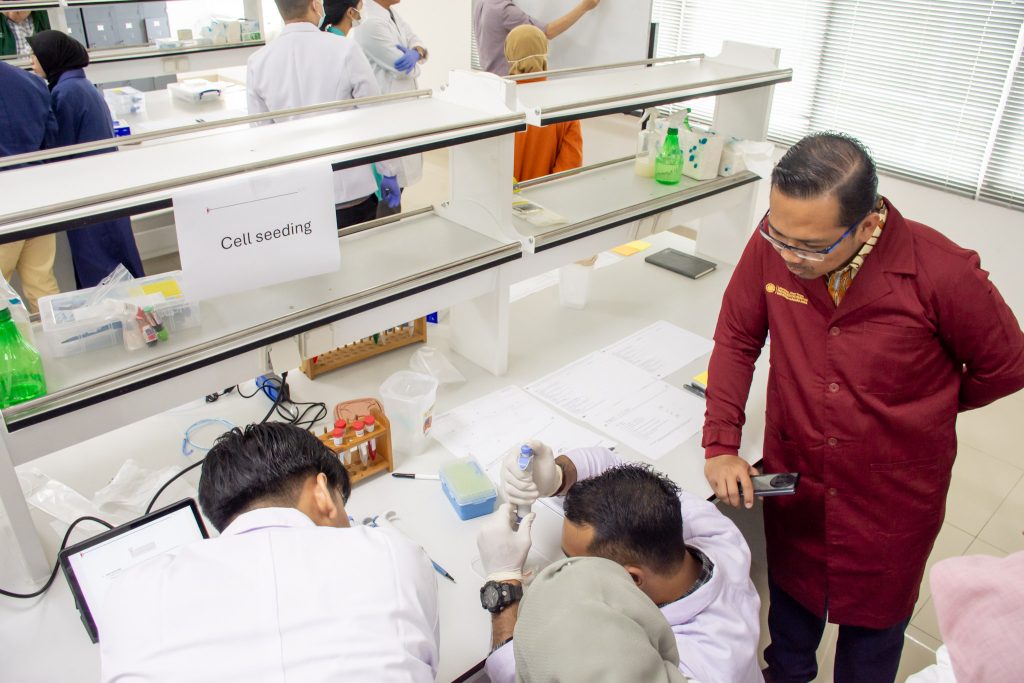
Andari Sarasati, a researcher in the field of oral soft tissue engineering, considers organ-on-a-chip to be a highly promising research platform for the future. According to her, this technology can reduce the use of experimental animals, thereby helping to minimize ethical issues while enhancing the credibility and effectiveness of in vitro research.
“Oral mucosal tissue has great potential to be studied using this technology, especially in understanding interactions or infections of various pathogens in the oral cavity, while also opening opportunities for the development of new drugs in the future,” said Andari.
Meanwhile, Prof. Dr. Eng. Yusril Yusuf, S.Si., M.Si., M.Eng., Head of the Integrated Research and Testing Laboratory (LPPT UGM), expressed his appreciation for the implementation of this activity as an important milestone for UGM in strengthening its interdisciplinary research ecosystem.
Prof. Yusril emphasized the importance of maintaining the sustainability of such training. He hopes that activities like this can strengthen international research networks while enriching students’ learning experiences, thereby preparing UGM to better face global research challenges.
Author and Photographer: Fajar Budi Harsakti

