
Distance Education (PJJ) at Universitas Gadjah Mada (UGM) is a form of learning that utilizes information technology, allowing students to study from anywhere without the need for physical attendance on campus. This program is implemented in accordance with the provisions of the Regulation of the Minister of Education and Culture No. 109 of 2013 concerning the Implementation of Distance Education. Its objective is to provide access to high-quality higher education for the wider community, respond to the need for learning flexibility in the digital era, and support the digital transformation of higher education in Indonesia.
PJJ Study Programs at UGM
To date, several programs that have been implemented or are currently being developed by UGM in the PJJ format include:
- Bachelor’s Program in Public Health (FKM UGM) – One of the most active PJJ programs, with official approval from the Ministry of Education, Culture, Research, and Technology.
- Bachelor’s Program in Psychology (Faculty of Psychology) – Currently under development.
- Bachelor’s Programs in Management and Accounting (FEB UGM) – Several courses have been offered in a hybrid format.
- Certain Master’s (S2) programs are also being prepared in a blended learning format.
At present, the Faculty of Dentistry, Universitas Gadjah Mada (FKG UGM), does not yet have an officially established Distance Education (PJJ) program like some other faculties (for example, FKM UGM with its PJJ in Public Health). However, FKG UGM has developed and prepared elements of distance oronline learningthat are aligned with PJJ principles. The aim is to leverage technology to enhance educational quality and expand access to knowledge, although clinical practice continues to be conducted directly (face-to-face at the FKG UGM teaching clinic).
Challenges of PJJ in Dentistry
The field of dentistry involves a substantial proportion of practical and clinical learning, therefore:
- Full PJJ cannot yet be implemented in its entirety,
- However, a hybrid learning model is considered the best solution (online theory, clinical practice on site).
With this experience, PJJ at FKG UGM has strong potential for future development, particularly for:
- Continuing Dental Education (CDE) programs, (Continuing Dental Education / CDE),
- Online training for dentists in regional areas, or
- Specialist professional programs with online theoretical components.
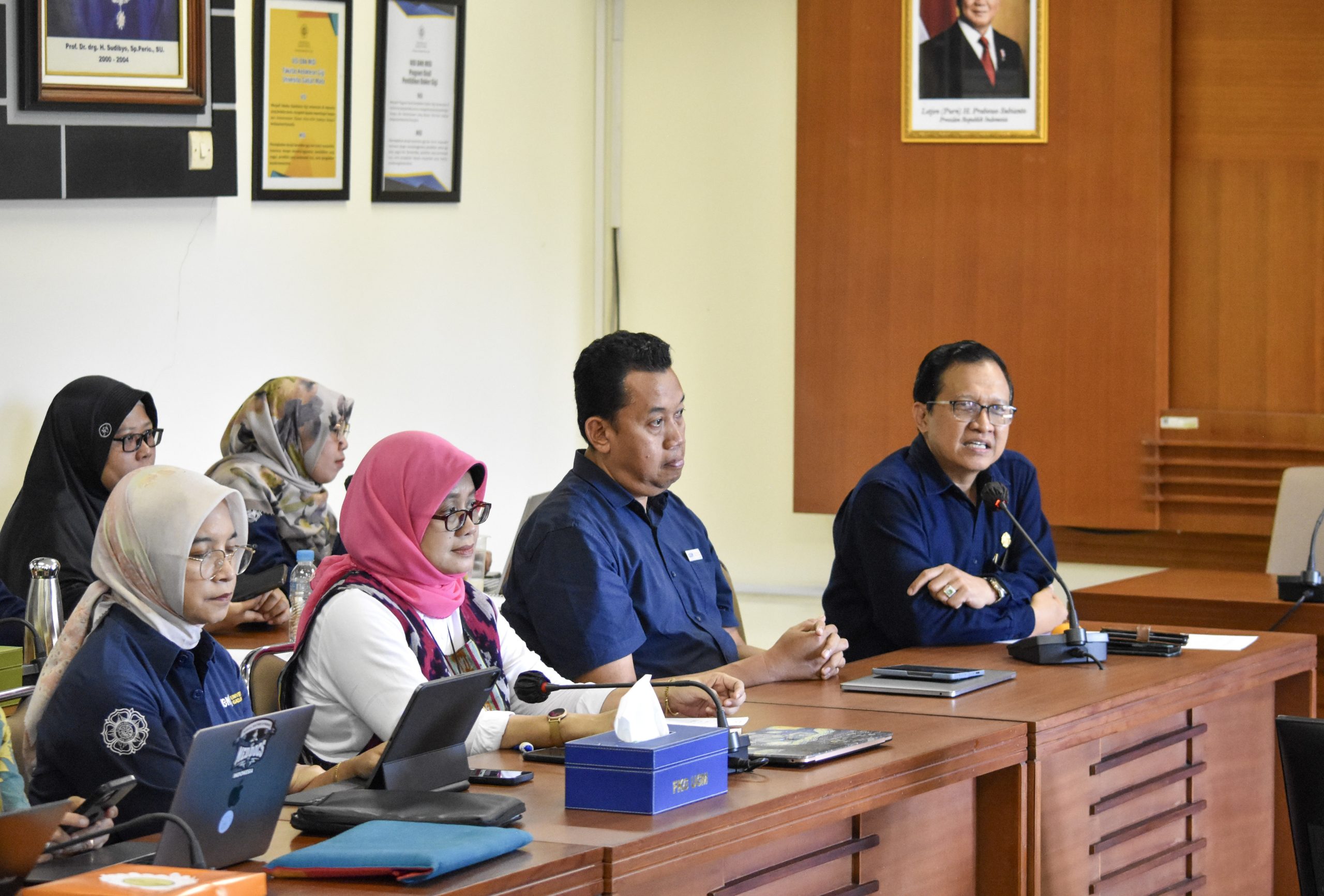
The Dean of FKG UGM, Prof. drg. Suryono, SH., MM., Ph.D., stated in his remarks, “There is no such thing as threats and challenges; there are only opportunities and efforts, because otherwise we will linger and stop at the conceptual stage.” He then shared his experience after returning from Central Kalimantan, specifically Lamandau Regency, where cooperation has been established to contribute to regional development through education. Lamandau Regency is among the wealthiest regencies in Central Kalimantan, with a poverty rate of only 3 percent. Uniquely, out of 12 community health centers and one regional general hospital, the number of dentists is still insufficient. Therefore, in line with UGM’s slogan, rooted strongly and reaching high, FKG UGM must truly contribute to society. It is hoped that FKG UGM can become a pioneer in PJJ if future regulations make this possible.
Author: Andri Wicaksono | Photo: Fajar Budi Harsakti

