
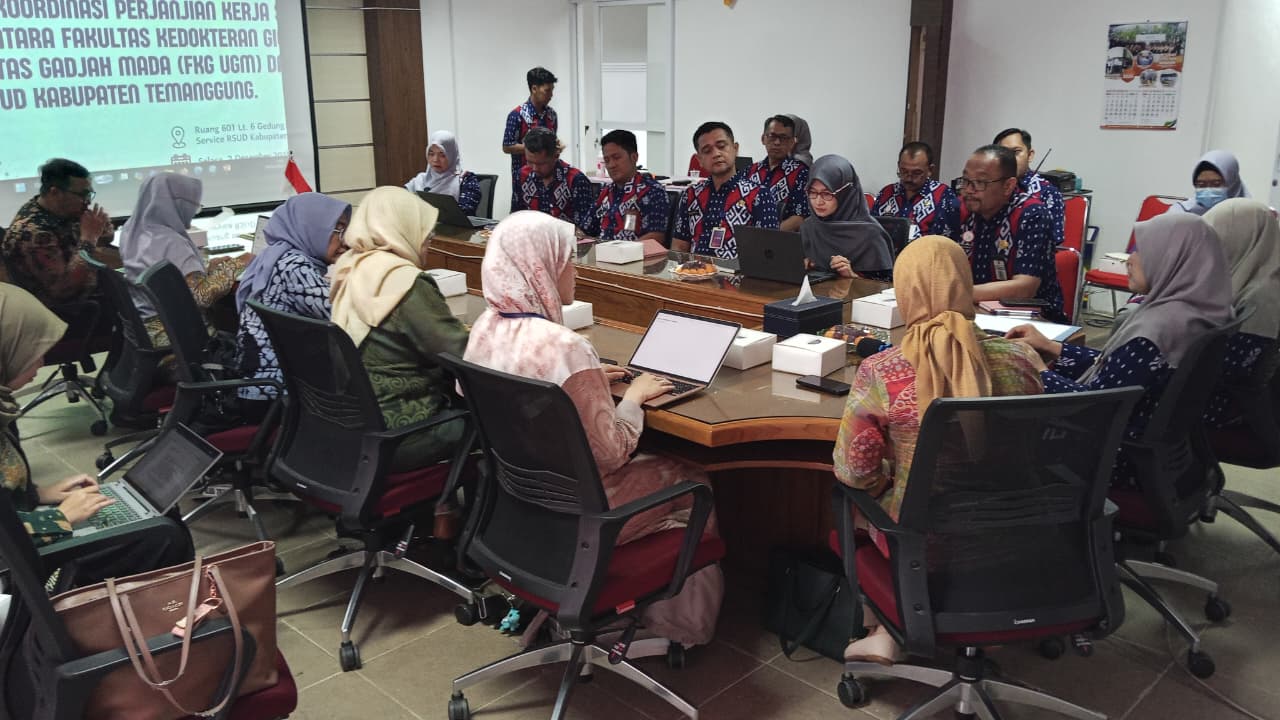
The Faculty of Dentistry, Universitas Gadjah Mada (FKG UGM), conducted a working visit to Temanggung Regional General Hospital (RSUD Temanggung) on Tuesday (December 2, 2025) to discuss strengthening Oral and Maxillofacial Surgery (OMS) services and synchronizing the deployment of residents. The meeting formed part of broader efforts to expand educational networks and improve healthcare service quality in Central Java. The FKG UGM delegation included the Vice Dean for Academic Affairs, Vice Dean for Cooperation and Community Service, Head of the Department of Oral and Maxillofacial Surgery, Head of the OMS Study Program, Head of the Cooperation Unit, and Head of Administrative Affairs.
In her remarks, RSUD Temanggung Director dr. Tetty Kurniawati, Sp.S., M.Kes, stated that the hospital has not yet received OMS accreditation from the Ministry of Health and does not have a permanent OMS specialist. This situation makes collaboration with FKG UGM essential to ensure service continuity. “We still rely on support from FKG UGM to meet OMS service needs. Our service standards are also aligned with faculty guidelines,” she said.
The Vice Dean for Academic Affairs of FKG UGM emphasized the faculty’s strategic role within the Academic Health System (AHS) fostered by the Ministry of Health for Yogyakarta, Central Java, and Kalimantan. Demand for OMS specialists continues to increase in line with regional healthcare needs. “This visit is important for evaluation, synchronization, and ensuring that resident training facilities operate according to established standards,” she explained.
RSUD Temanggung as a Primary OMS Referral Center
Discussions revealed that RSUD Temanggung currently serves as the only hospital in the surrounding region actively providing OMS services. The hospital handles referrals from Magelang and Kendal, performing an average of 3–5 surgeries per day and approximately 30 daily cases. The most common cases include facial trauma, impacted teeth, and maxillofacial tumors.
However, the absence of a permanent OMS specialist remains a major challenge. Services currently depend on attending physicians from FKG UGM, particularly drg. Bramasto, who is scheduled to be present daily. This arrangement is considered unsustainable for both human resource development and resident education standards.

DPJP Scheduling and BPJS Regulations Under Review
A key issue discussed was BPJS regulations prohibiting overlapping physician schedules, which often attract audit scrutiny. FKG UGM proposed a new rotating assignment system—similar to practices at RSPAU Hardjolukito—where multiple attending physicians serve on designated days.
Resident deployment will continue with supervision based on competency levels, coordinated with the Study Program and aligned with attending physician schedules.
RSUD Temanggung’s Commitment: Resident Accommodation and Service Fee Schemes
RSUD Temanggung reaffirmed its commitment to supporting sustainable educational facilities. Resident accommodation has been provided within the hospital area, and management is considering transportation arrangements based on internal discussions.
The hospital also requested clearer provisions regarding service fees for attending physicians and residents within the Cooperation Agreement (PKS). Additionally, RSUD Temanggung is awaiting clarification on the implementation of its Mentor Hospital status, expected to take effect in December 2025, which is anticipated to assist in regulating the authority of attending physicians and residents.
Next Steps: Human Resource Planning, Revised PKS, and Periodic Evaluation
As a follow-up, FKG UGM will hold internal meetings to discuss attending physician scheduling, including the possible assignment of two specialists, as well as adjustments to resident supervision mechanisms. RSUD Temanggung will prepare an official letter outlining DPJP requirements as the administrative basis for a revised PKS.
The revised agreement will include provisions on DPJP schedules, service fee schemes, resident obligations, and supporting facilities to be provided by the hospital.
Both institutions agreed to conduct regular monitoring and evaluation to ensure optimal OMS service quality while maintaining high standards of resident education.
(Reporter: Andri Wicaksono | Photo: Bernadeta Ayu)

