
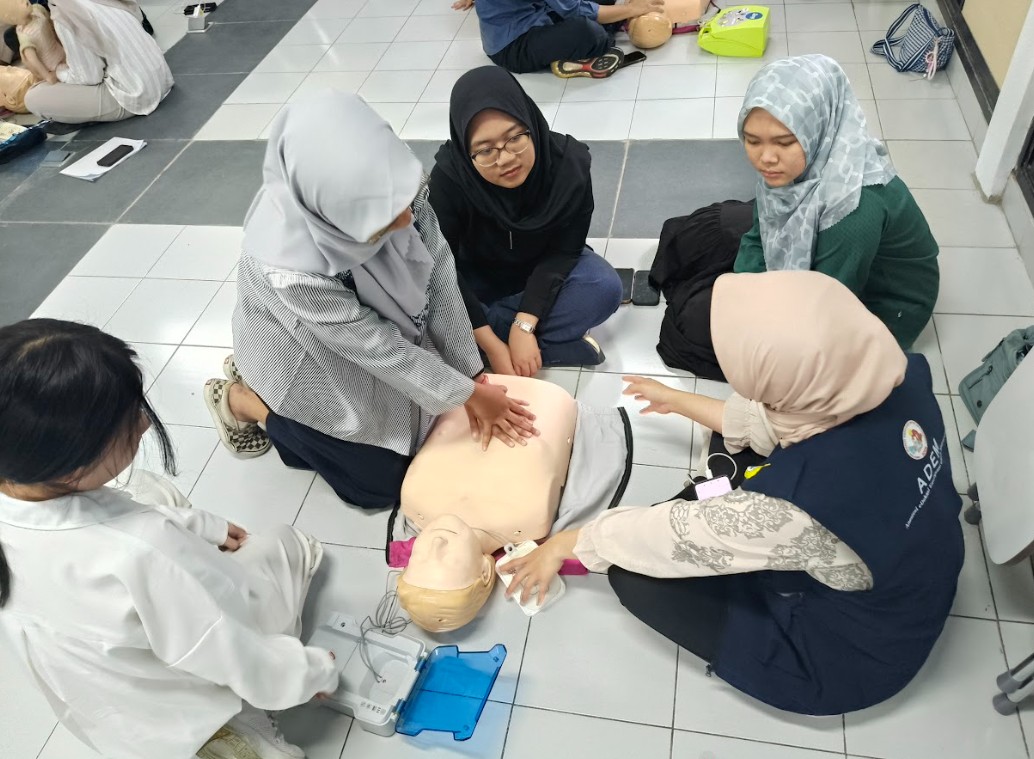
EMERALD was once again held as one of the key learning agendas at the Faculty of Dentistry, Universitas Gadjah Mada (FKG UGM). This program is designed to equip dental students with the skills required to respond to emergency situations, both medical and dental, that may arise at any time in clinical settings or community health services.
As future dentists, the ability to provide rapid and accurate responses in critical conditions is a non-negotiable competency. This is where EMERALD serves as a bridge between dental theory and the often dynamic realities of clinical practice.
Relevance of EMERALD to the Tri Dharma of Higher Education and Its Impact on Society
The implementation of EMERALD is closely aligned with the Tri Dharma of Higher Education, particularly in the areas of education and community service. Through a series of theoretical sessions and hands-on practice, students not only learn emergency concepts but also apply practical skills that will later be used when serving in healthcare facilities.
The impact extends beyond individual competency development to the overall improvement of dental healthcare services in the community. With a thorough understanding of emergency management—ranging from post-extraction bleeding to acute temporomandibular joint (TMJ) dislocation cases—these prospective dentists are expected to deliver prompt, safe, and effective care.
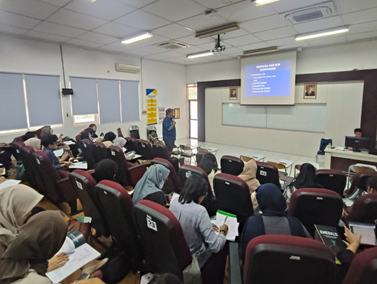
EMERALD 2025 was conducted at the FKG UGM campus, utilizing Room E of the Harkati Dewanto Building for theoretical learning sessions, and Room G of the Sutatmi Suryo Building as well as the Margono Suradji Auditorium for skills lab sessions. These locations were selected to support a structured learning model integrating theory and practice.
EMERALD 2025 Activities
EMERALD was held on 12, 13, and 19 November 2025 and organized into four major groups. As in previous years, the program consisted of two main components: theoretical learning and emergency clinical skills laboratories.
The theoretical materials covered a range of emergency conditions commonly encountered in dental practice. During the skills sessions, participants engaged in hands-on practice using mannequins and clinical modules. Each topic was facilitated by experts in their respective fields, with a focus on: Flap techniques, Suturing, Management of oroantral communication, Dry socket management, Airway obstruction, and Basic Life Support. Through this hands-on approach, students not only learned procedures but also developed clinical sensitivity in rapidly assessing patient conditions.
Role of Speakers and Collaborators
The EMERALD program was made possible through collaboration between the Undergraduate Dental Program of FKG UGM, through the Department of Oral and Maxillofacial Surgery, and PABMI (DIY Regional Chapter) as well as PERDATIN (DIY Regional Chapter).
Several oral and maxillofacial surgery specialists and expert speakers contributed to the program, including:
- drg. Poerwati Soetji Rahajoe, Sp.B.M.M., Subsp.T.M.T.M.J.(K), Ph.D.
- drg. Cahya Yustisia Hasan, Sp.B.M.M., Subsp.C.O.M.(K)
- drg. Didit Istadi, Sp.B.M.M., Subsp.Ped.O.M.(K)
- drg. Muhammad Bakhrul Lutfianto, Sp.B.M.M., Subsp.C.O.M.(K)
- drg. Pingky Krisna Arindra, Sp.B.M.M., Subsp. Ped.O.M.(K)
- Drg. Edwyn Saleh, M.A.R.S., Sp.B.M.M.
- drg. Indria Nehriasari, M.Kes., Sp.B.M.M.
- drg. Adi Subekti Putra, Sp.B.M.M., Subsp.T.M.T.M.J.(K)
- Dr. drg. Bramasto Purbo Sejati, Sp.B.M.M., Subsp.T.M.T.M.J.(K)
- drg. Yosaphat Bayu Rosanto, M.DSc., Sp.B.M.M., Subsp.I.D.M.(K)
- drg. F. X. Indra Kariadi, Sp.B.M.M.
- drg. Erdananda Haryosuwandito, Sp.B.M.M.
- drg. Fajar Januar Mirhard, Sp.B.M.M.
For the Basic Life Support module, instructors from PERDATIN DIY were involved, namely dr. Febrian Naufaldi, Sp.An-TI, along with residents from the Department of Anesthesiology and Intensive Therapy, FK UGM.
This collaboration ensured that students received not only theoretical knowledge but also practical experience aligned with hospital service standards.
EMERALD serves as a comprehensive platform for undergraduate dental students at FKG UGM to prepare for emergency situations in clinical practice. The program not only supports institutional educational outcomes but also strengthens the faculty’s contribution to improving community healthcare quality. Through the integration of theory, technical skills, and situational training, prospective dentists are expected to deliver more responsive, safe, and professional services.
(Contributor: drg. Ryan Cristian P. | Photo: Department of Oral and Maxillofacial Surgery FKG UGM | Editor: Andri Wicaksono)

