
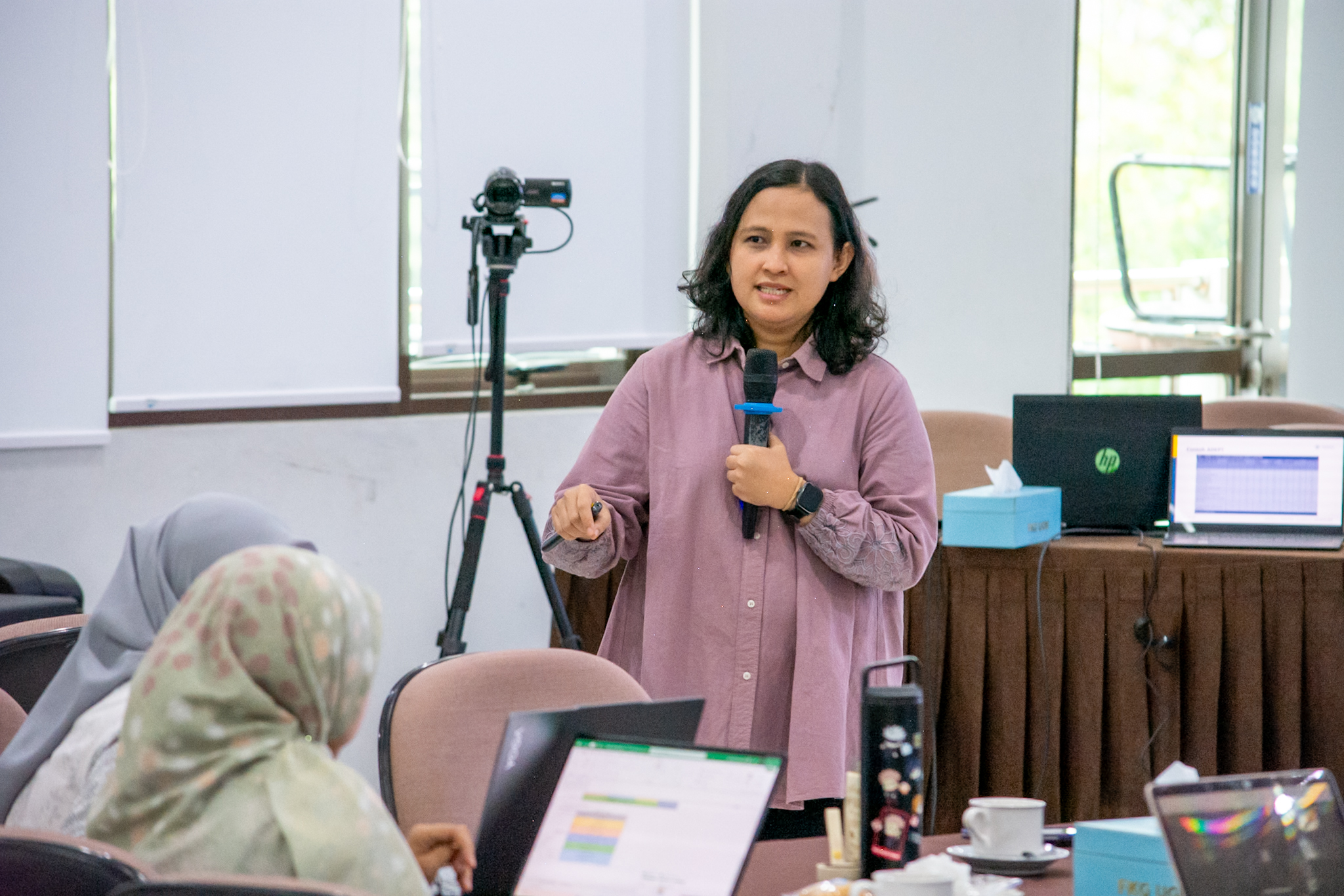
Assessment systems in clinical dental education should not rely solely on a single type of examination (single assessment) , but instead be integrated into a comprehensive system capable of monitoring students’ competency development holistically. This was stated by drg. Fimma Naritasari, MDSc., as a speaker at the Workshop on Enhancing Assessment Systems and Updating the Dental Clinical Clerkship Logbook, held on Thursday, 18 December 2025.
During the workshop, drg. Fimma emphasized the importance of implementing Programmatic Assessment, an assessment system that integrates multiple instruments to provide a comprehensive picture of student competence. According to her, this approach is necessary to ensure that assessment functions not only as an end-of-program evaluation (assessment of learning), but also as a tool to improve the learning process (assessment for learning) through regular and constructive feedback.
This approach is implemented through the use of various clinical assessment instruments, such as the Mini Clinical Evaluation Exercise (Mini-CEX), Case-Based Discussion (CBD), and OSLER. These methods aim to assess students at the highest level of Miller’s Pyramid, namely the Does level, which measures actual student performance in managing patients directly within clinical settings.
“Competence is a combination of knowledge, skills, attitudes, and values that are integrated. Therefore, assessment must cover multiple aspects such as communication skills, clinical reasoning, and professionalism, which cannot be adequately measured through a single examination,” she explained.
The refinement of the system also includes updating the clinical clerkship logbook with standardized assessment rubrics to reduce assessor subjectivity. With more detailed guidelines, clinical supervisors are expected to provide more objective evaluations and better support students in achieving the required competency standards as future dentists.
Meanwhile, the Vice Dean for Academic and Student Affairs of FKG UGM, Prof. drg. Rosa Amalia, M.Kes., Ph.D., stated that although the current assessment system is generally effective, several aspects still require adjustment and improvement as part of the faculty’s ongoing commitment to enhancing the quality of professional education.
Furthermore, Prof. Rosa explained that the Dental Professional Program (clinical clerkship/koas) is targeted to be completed effectively within four semesters. “Substantively, the primary learning outcomes are expected to be fully achieved by the third semester, while the fourth or final semester is specifically allocated for strengthening and refining student competencies before entering professional practice,” she concluded.
Writer and Photographer: Fajar Budi Harsakti

