
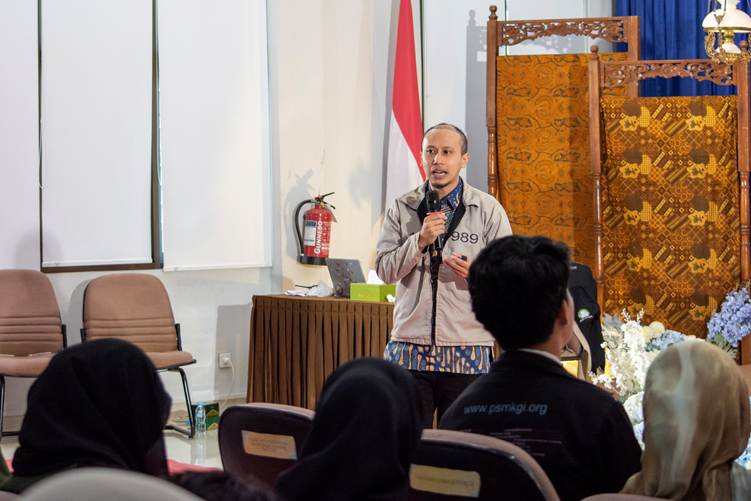
Opening of PSMKGI XIX
In fabricating complete dentures, the anatomy of the upper and lower jaws must be fully captured—from the tuberosity and hamular notch to the retromolar pad—to ensure adequate retention and stability. Cross-specialty collaboration among prosthodontics, orthodontics, and oral surgery has become increasingly significant in managing complex cases. drg. Mohammad Fadyl Yunizar, M.PH., Ph.D., delivered this presentation at the Opening of PSMKGI XIX.
Dental education in Indonesia stands at an important crossroads. On one hand, conventional methods remain the foundation of prosthodontic learning. On the other, digital transformation drives changes in workflow that demand rapid adaptation from educational institutions and future dentists alike.
These shifts emerged in academic discussions covering prosthodontic practice—from denture impressions to the application of computer-aided design/computer-aided manufacturing (CAD/CAM) technology. The discussion emphasized that minor early-stage errors—such as incomplete anatomical impressions—can have long-term consequences up to final placement.
In conventional practice, alginate or silicone impressions are still widely used. However, these methods present challenges: material dimensional changes, porous impressions, and inaccuracies sometimes detected only after processing and patient try-in. When errors occur, the process often must be repeated from the beginning.
INITIAL PRECISION DETERMINES OUTCOME
Educators emphasized that prosthodontic success begins with the study model stage. Complete recording of upper and lower jaw anatomy—from the tuberosity and hamular notch to the posterior molar area—is essential for adequate retention and stability.
Errors at this stage impact not only technical aspects but also clinical outcomes. An excessively high or imbalanced bite, for instance, can trigger long-term discomfort, temporomandibular joint (TMJ) disorders, and headaches.
Occlusal adjustment is another critical stage often overlooked. Without proper adjustment, dentures or restorations may appear visually satisfactory but functionally problematic.
THE ARRIVAL OF DIGITAL TECHNOLOGY
Digital advancements offer solutions to some of these challenges. Intraoral scanners enable direct recording of jaw anatomy without conventional impression materials, reducing distortion risks and patient discomfort.
With CAD/CAM systems, denture designs can be digitally created and produced via milling or 3D printing. In chairside concepts, the entire process—from preparation to placement—can even be completed in a single visit.
However, adoption is not without obstacles. The initial investment in digital equipment is substantial, with intraoral scanners costing hundreds of millions of rupiah, excluding software and production machines. As a result, implementation remains uneven, especially in institutions with limited budgets.
CURRICULUM AND ETHICAL CHALLENGES
At undergraduate and professional levels, digital technology is generally introduced as foundational material. Students learn basic scanning and digital design principles but are not yet fully immersed in technology-based clinical practice.
Ethical concerns also arise. Detailed exposure of clinical procedures on social media risks misuse by unqualified individuals, including illegal practices that could endanger patients.
PREPARING FUTURE DENTISTS
Digital transformation in prosthodontics is ultimately not just about tools, but about paradigm shifts. Cross-specialty collaboration among prosthodontics, orthodontics, oral surgery, and maxillofacial rehabilitation is increasingly vital in complex case management.
For dental education, the challenge lies in balancing mastery of conventional fundamentals with readiness for future technology. Clinical precision, anatomical understanding, and professional ethics remain foundational, while technology serves as a tool to enhance service quality.
Amid changing times, one principle endures: “The best treatment outcomes always begin with precision from the very first step.”
Reporter: Andri Wicaksono, Photographer: Fajar Budi Harsakti

