
Metal brackets, archwires, and bands attached to the teeth of orthodontic patients are not merely tools for straightening smiles. For bacteria, these components provide an ideal hiding place. The narrow spaces between brackets and tooth surfaces create niches that are almost impossible to reach with an ordinary toothbrush—and this is where Aggregatibacter actinomycetemcomitans can quietly thrive.
This bacterium is far from harmless. It is recognized as one of the most aggressive periodontal pathogens and can potentially damage the tissues supporting the teeth if allowed to proliferate freely within dental plaque biofilms. The question is whether there is a sufficiently powerful natural agent capable of controlling it without relying entirely on chemical antiseptics.
Research conducted by Lintang Wulandari under the supervision of Dr. drg. Andi Triawan, Sp.Ort., and Dr. drg. Cendrawasih Andusyana Farmasyanti, M.Kes., Sp.Ort(K)., from Universitas Gadjah Mada, attempted to answer this question. The findings were surprising and opened up broader avenues for discussion.
Smaller Chitosan, Greater Potential
Chitosan is not a new material in healthcare. This biopolymer derived from chitin has long been recognized for its antibacterial properties, biodegradability, and relative safety for the human body. However, conventional chitosan has limitations: its relatively large particle size reduces its ability to penetrate bacterial membranes effectively.
This is where nanocitosan comes into play. By reducing particle size to the nanometer scale, the surface area available for contact with bacteria increases dramatically. The positive charge on the nanocitosan surface interacts directly with the negatively charged bacterial cell membrane, disrupting its integrity until the bacteria lose their ability to survive.
The study used a nanocitosan concentration of 0.6%, slightly higher than the 0.5% concentration of conventional chitosan that had previously been shown to inhibit A. actinomycetemcomitans. The bacteria used in the experiment were collected directly from the dental plaque of patients undergoing fixed orthodontic treatment rather than from sterile laboratory strains. This approach made the findings more closely representative of actual clinical conditions.
Well Diffusion Method and the Numbers That Matter
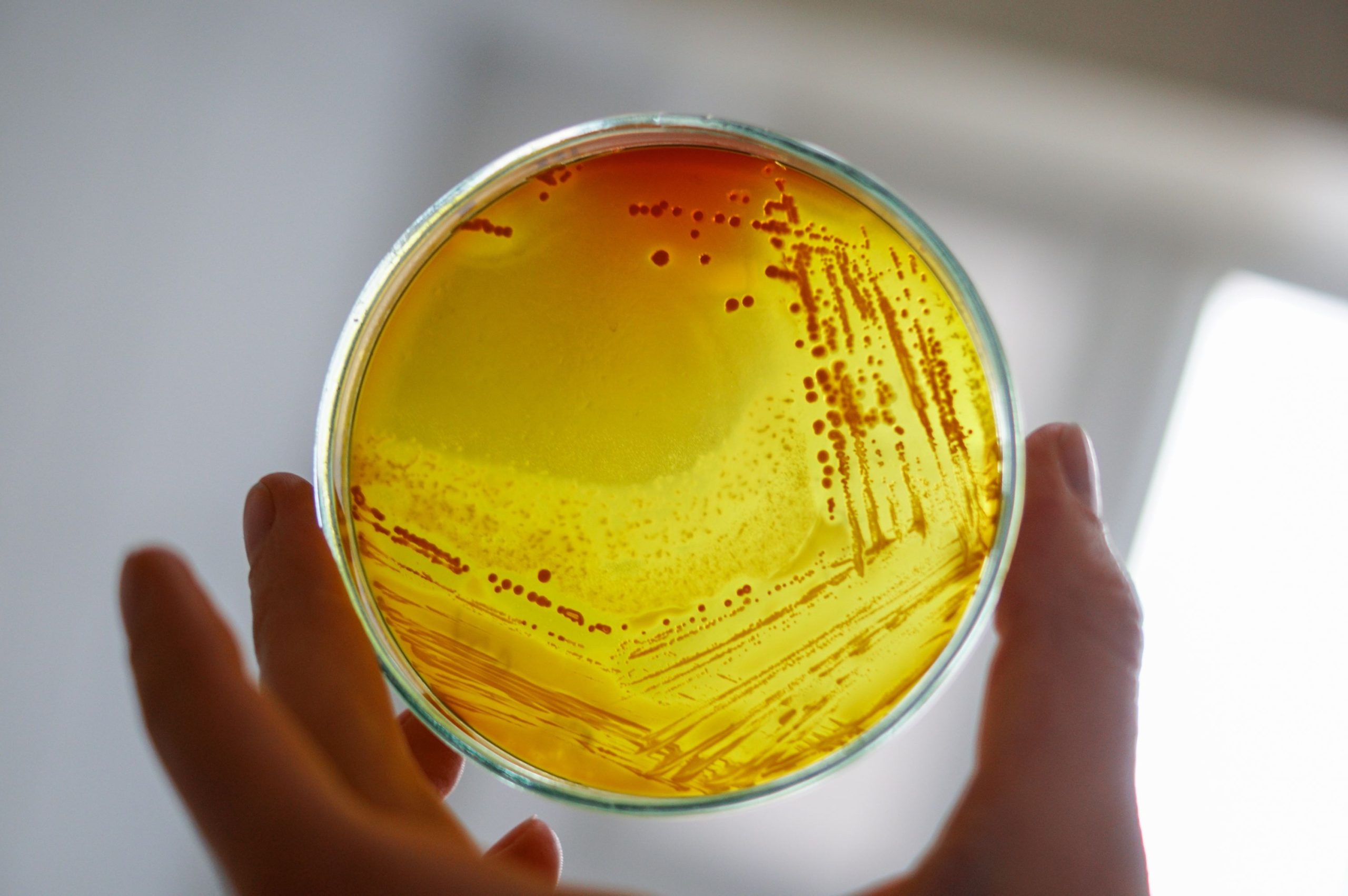
Antibacterial activity was evaluated using the well diffusion method. Bacteria were inoculated onto Petri dishes, after which small wells were created and filled with the test solutions. The clear zone formed around each well, known as the inhibition zone, was used to measure how effectively a solution suppressed bacterial growth. Measurements were taken using a caliper with a precision of 0.01 mm.
Three groups were compared: 0.6% nanocitosan as the treatment group, 0.2% chlorhexidine gluconate as the positive control, and distilled water as the negative control. A total of 18 samples were evenly distributed among the three groups.
The Kruskal-Wallis test produced a significance value of 0.000, well below the threshold of p < 0.05. This indicated a statistically significant difference among the three groups. A subsequent Mann-Whitney test confirmed that the differences were specifically present between the respective groups.
“A 0.6% nanocitosan solution was able to inhibit the growth of Aggregatibacter actinomycetemcomitans bacteria, although its inhibitory effect was weak.”
This concluding statement may sound simple, but it contains an important nuance. Nanocitosan works and produces a measurable inhibition zone. However, its antibacterial activity is not yet comparable to that of chlorhexidine gluconate, the gold-standard oral antiseptic that has long served as a clinical reference.
Between Promise and Limitations Requiring Further Study
These findings place nanocitosan in an interesting position: not an immediate replacement for chlorhexidine, but a complementary candidate worthy of further development. Chlorhexidine is highly effective, but long-term use can have consequences, including tooth discoloration, altered taste perception, and concerns regarding microbial resistance.
Nanocitosan, derived from a natural source and considered biocompatible, offers a potentially more favorable safety profile. If its concentration or formulation can be optimized, its inhibitory activity may potentially be increased to a level with greater clinical significance.
It should also be noted that this study was in vitro, meaning that it was conducted outside the human body under controlled laboratory conditions. The oral cavity is considerably more complex, involving salivary flow, interactions with other bacteria, variations in pH, and patient behavioral factors, all of which can influence the effectiveness of antibacterial agents. The next step—in vivo testing in animal models or even clinical trials in humans—will determine whether this potential can truly be harnessed in orthodontic care.
Meanwhile, for the millions of patients currently wearing braces and struggling to brush their teeth more thoroughly every night, research like this serves as a reminder that science is working behind the scenes to find ways to ensure that the journey toward a straighter smile does not come at the expense of periodontal health.
Authors: Nanda Ayu, drg. Achmad Zam Zam Aghasy, M.Kes.
Photo: Pexels