
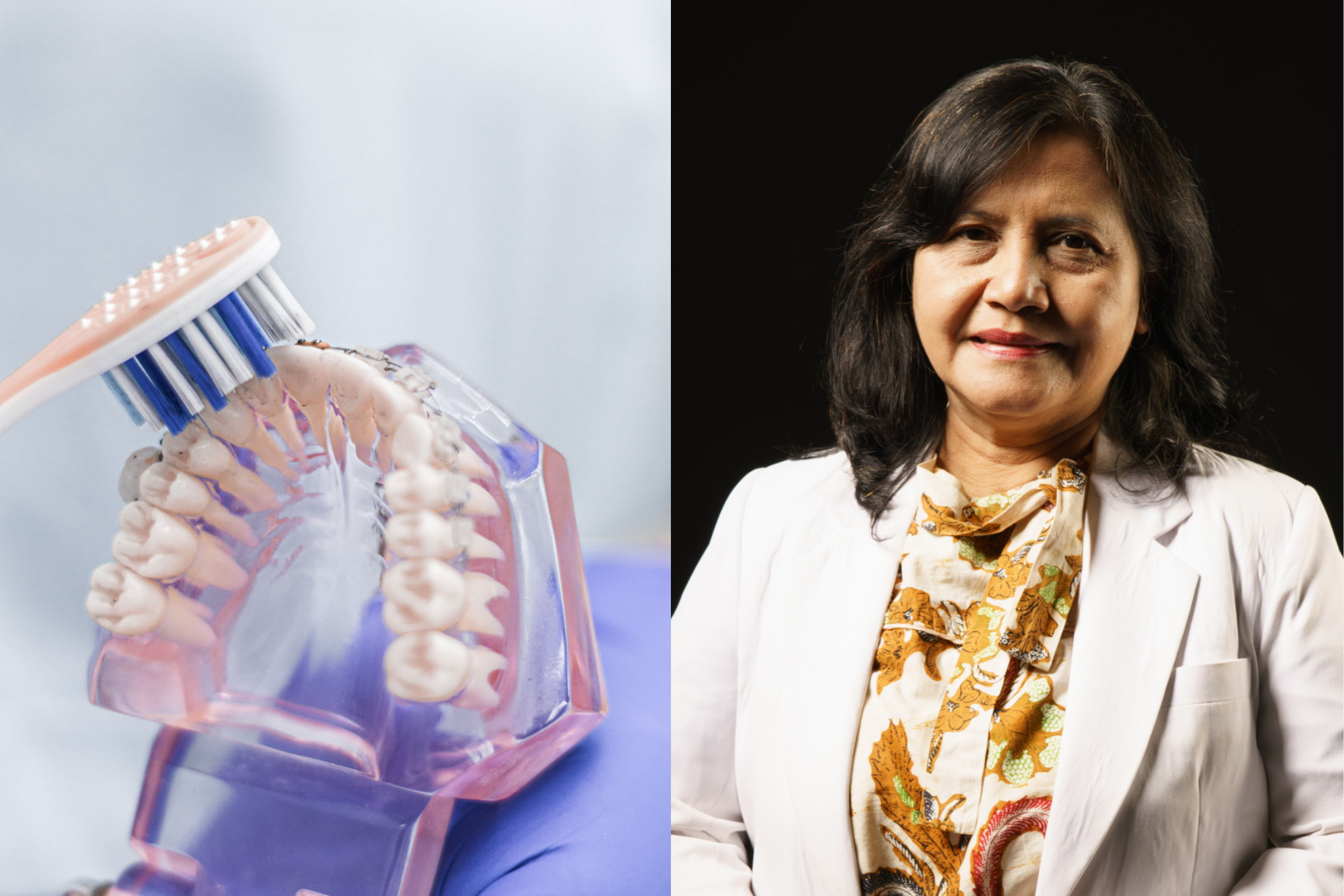
Imagine a paediatric dentist planning orthodontic treatment for a 12-year-old patient. The dentist measures the lower incisors, enters the figures into a standard international prediction table, and then determines whether there is enough space in the jaw for the unerupted canines and premolars. That decision determines whether tooth extraction will be necessary. The problem? The table was developed using dental data from white American children—not Javanese children.
This was the issue that prompted Prof. drg. Sri Kuswandari, MS., Sp.KGA., Ph.D., from the Department of Paediatric Dentistry, Faculty of Dentistry, Universitas Gadjah Mada, together with a research team from Tokushima University, Japan, to investigate data from 285 schoolchildren in Yogyakarta. Their findings, published in the Pediatric Dental Journal in 2006, demonstrated that two of the world's most widely used prediction methods—the Moyers and Tanaka-Johnston methods—consistently underestimated tooth size when applied to Javanese children.
Why Tooth Prediction Matters
The mixed dentition period, when primary and permanent teeth are present simultaneously in the same jaw, is a critical window in the development of a child's occlusion. At this stage, paediatric dentists must determine whether the available space in the dental arch is sufficient to accommodate the canines, first premolars, and second premolars that are still developing within the bone.
The Moyers and Tanaka-Johnston methods have long been relied upon because they are simple: dentists only need to measure the mesiodistal widths of the four lower incisors and then match the measurements with a probability table. No radiographs or specialised equipment are required. The process is practical and quick.
However, this convenience comes with a potential pitfall. Both methods were developed using data from white American populations, whose tooth sizes have been shown to be smaller than those of Javanese children. When Prof. Kuswandari and her team compared the predictions generated by these methods with the actual tooth sizes obtained from 285 dental casts of Yogyakarta children aged 11 to 14 years, the results were concerning: both methods consistently underestimated the size of the canine-premolar segment, particularly in boys.
Lower Incisors Are Not the Best Predictors for Javanese Children
The most striking finding was not simply confirmation that these Western methods were unsuitable. More importantly, the study revealed why they were inadequate—and what could be used instead.
In other populations, the correlation between the combined widths of the mandibular incisors and the size of the canine-premolar segment is relatively strong, ranging from 0.63 to 0.79, for example, among Hong Kong Chinese children. Among Javanese children, however, the correlation was only 0.56 to 0.66. This means that the lower incisors are not a sufficiently reliable predictor of canine and premolar tooth size in this population.
The research team then tested various combinations of other tooth groups as predictor variables. They found that the combination of the maxillary first molar and mandibular lateral incisor produced a stronger correlation, ranging from 0.67 to 0.73, outperforming the incisor combination that had traditionally been used as the standard. The maxillary first molar proved to be the most dimensionally stable tooth among all the dental elements examined.
Based on these findings, Prof. Kuswandari developed a new linear regression equation specifically for Javanese children, along with a clinical probability table that could be readily applied in practice. The accuracy of the new equation, as measured by the coefficient of determination and standard error of estimate, was consistently better than that of the Tanaka-Johnston equation and equations based on the mandibular incisors.
Numbers That Speak to Biological Identity
The descriptive data from the study also provided important insights. The mean width of the maxillary canine-premolar segment among Javanese boys was 23.05 mm, compared with 22.34 mm among girls. These figures were consistently greater than the values predicted by the Moyers and Tanaka-Johnston methods, which estimated only 22.14 mm and 22.61 mm, respectively, for boys.
A difference of less than one millimetre may appear insignificant. However, in orthodontic treatment planning, such a difference can potentially influence the decision of whether or not to extract a tooth.
"Tooth size differences among races are an important variable that must be concerned in a prediction equation."
This sentence, written in the study's discussion, is more than a scientific observation. It serves as a reminder that biological data are shaped by population characteristics, and that standards developed from one population cannot simply be transferred to another without proper validation.
A Data Legacy for Future Clinicians
The study collected data from 3,832 children across 16 junior high schools and five elementary schools in Yogyakarta during 2000–2001—a substantial field research effort. Dental impressions were taken from each participant, cast in hard plaster, and each tooth was measured twice at different times using a caliper with an accuracy of 0.05 mm.
The outcome was more than just a research paper. The probability tables generated from the new regression equations were specifically designed for clinical use, providing an alternative to the Moyers tables that had been displayed on Indonesian paediatric dentists' desks for years.
More than two decades after the data were collected, the question raised by this study remains relevant: how many of the clinical guidelines we use every day are actually built upon data from our own populations? For Javanese children sitting in the dental chair with their mixed dentition, the answer is now a little clearer.
Authors: Nanda Ayu, drg. Achmad Zam Zam Aghasy, M.Kes.
Photo: https://fkg.ugm.ac.id/wp-content/uploads/sites/30/2024/10/Dok-Sri-Kuswandari.jpg
