
Behind the white coat and professional smile of a dentist lie shortened hours of sleep, thinning wallets, and mental resilience tested repeatedly. Life as a clinical clerk (koas) and resident is not merely an academic phase, but a human journey of endurance.
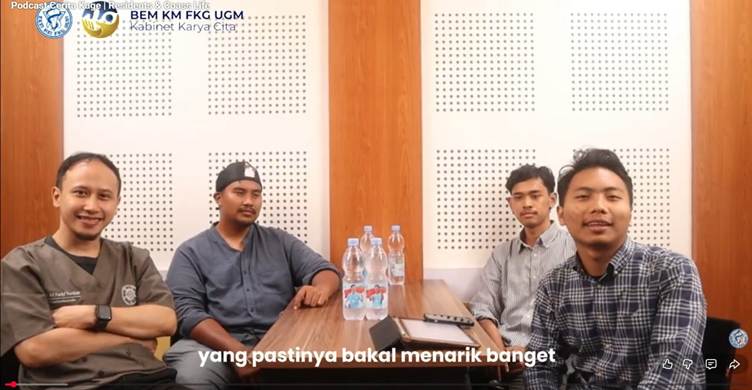
In a modest recording room, three generations of future dentists sat side by side: a professional program student (koas), two specialist residents, and a young moderator. They opened a conversation about a topic rarely discussed openly—the realities behind clinical dental education.
The discussion, recorded in a collaborative podcast by HMPKG–GAMAPRO–BEM KM FKG Universitas Gadjah Mada, featured drg. Mohammad Fadyl Yunizar, M.PH., Ph.D., a Prosthodontics resident and lecturer; drg. Hirzi, an Oral Surgery resident with a background as a regional civil servant dentist; and Arya, a professional program student currently undergoing clerkship. From this space flowed candid stories of fatigue, sacrifice, and mental fortitude.
CLERKSHIP: A SCHOOL OF MENTAL STRENGTH, NOT JUST GRADES
For Arya, the clerkship phase marked a turning point from student life. If preclinical education focused on grades and theory, success in clerkship changes drastically.
“Being smart isn’t number one. Mental strength is,” he said.
Clerkship requires students to find their own patients, manage their own schedules, and bear social and emotional costs not written in the syllabus. Often, students must pick up patients from remote areas, cover their meals, and sacrifice personal time for a single clinical procedure.
Within a requirements-based education system, one day without a patient means one day further from graduation. “Delaying one day means delaying graduation,” Hirzi noted, recalling his own clerkship experience before entering residency.
RESIDENCY: WHEN LIFE IS NO LONGER YOUR OWN
If clerkship tests mental resilience, residency tests life endurance. Hirzi, formerly a government-employed dentist in South Kalimantan, described this phase as the most challenging.
Income stops. Family responsibilities increase. Academic and clinical demands multiply. Scholarships may help financially, but psychological pressure remains.
“Before, I asked my parents for money. Now my wife asks me—but I don’t have it,” he shared.
Meanwhile, Fadyl pursued residency while serving as a lecturer and holding structural responsibilities within the faculty. Time became scarce. Sleep was often sacrificed, tasks completed in the early hours, and weekends rarely provided true rest.
Yet they shared one common thread: delayed gratification.
“We’re just postponing pleasure. The curriculum is five years—very long. But the results are worth it,” Hirzi said.
BECOMING A SPECIALIST: KNOWLEDGE REPEATED HUNDREDS OF TIMES
The most visible difference between clerkship and residency lies in academic focus. Clerkship demands comprehensive understanding of dentistry. Residency narrows into deep specialization.
“If a clerk extracts 20 teeth, we might do it 500 times,” Hirzi explained. Repetition shapes specialist expertise—competence that cannot be gained from online videos or brief experiences.
Fadyl added that clinical experience must align with evidence-based approaches. Without scientific grounding, clinical practice risks becoming untested habit.
By the end of the conversation, the speakers agreed that dental education is not merely about medical expertise—it is character education.
It is about inevitable failure. About rising after being rejected by a supervisor. About finding peers who strengthen rather than undermine one another. About not neglecting spiritual responsibilities amid worldly busyness.
“The finish line exists. It’s just not time to stop,” Arya concluded.
There was no glorification in that podcast room—only honesty. Becoming a dentist, especially a specialist, is a long and quiet journey, yet meaningful. A journey of ordinary people learning patience before being entrusted to care for others.
(Reporter: Andri Wicaksono; Photo: Screenshot from the Cerita Kage Podcast YouTube channel)