
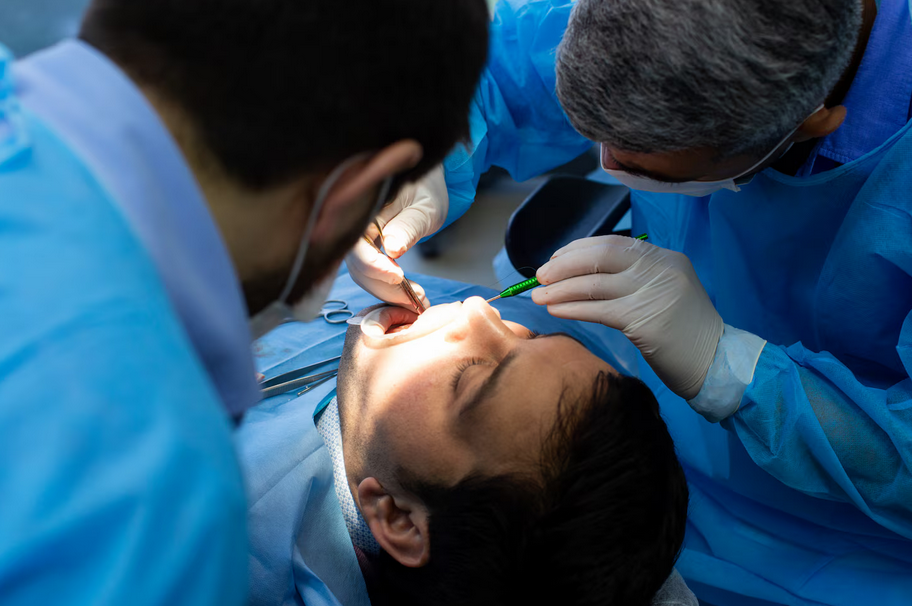
Periodontitis is a chronic inflammatory disease affecting the supporting tissues of the teeth, including the gingiva, periodontal ligament, and alveolar bone. The disease is primarily caused by pathogenic bacterial infections that trigger excessive immune responses, resulting in the destruction of tooth-supporting structures.
To control inflammation, conventional therapies such as scaling and root planing (SRP) are often combined with pharmacological treatments. However, systemic anti-inflammatory drugs have limitations, including gastrointestinal side effects and non-targeted drug distribution. Therefore, local anti-inflammatory therapy has emerged as a promising approach to improve the effectiveness of periodontitis treatment.
Principles of Local Anti-Inflammatory Therapy
Local anti-inflammatory therapy aims to deliver medication directly to the infected periodontal area at high therapeutic concentrations while minimizing systemic side effects. Common forms of local therapy include:
- Anti-inflammatory gels or ointments, such as metronidazole, doxycycline, or chlorhexidin
- Microspheres and nanofibers based on biodegradable polymers, which function as controlled drug delivery systems
- Subgingival irrigation using antiseptic solutions or anti-inflammatory agents
This local approach ensures high drug concentrations within the gingival sulcus, prolongs drug exposure to bacteria, and accelerates tissue healing.
The Role of Nanotechnology in Local Therapy
Advances in materials science and pharmaceutical technology have opened opportunities for applying nanotechnology to enhance the effectiveness of local periodontitis therapy. One innovative approach involves polymer-based nanofibers capable of controlling the sustained release of anti-inflammatory drugs.
A study conducted by an FKG UGM student, Dian Widiyaningrum, under the supervision of Dr. drg. Dahlia Herawati, SU., Sp.Perio(K), and Prof. Dr. drg. Sudibyo, SU., Sp.Perio(K), entitled “The Effect of Adding Moringa (Moringa oleifera Lam.) Leaf Extract to Chitosan-PVA Polymer on Nanofiber Drug Release,” contributes significantly to the development of biomaterial-based drug delivery systems.
The findings indicate that the addition of moringa leaf extract—rich in flavonoids and polyphenols with antioxidant and anti-inflammatory properties—affects the drug release characteristics of chitosan-PVA nanofibers. This system has potential as a local carrier for anti-inflammatory therapy in periodontal tissues because it:
- Enhances drug bioavailability at the target site
- Reduces the frequency of drug application
- Maintains the stability of active compounds in the complex oral environment
Thus, the use of natural materials such as moringa leaf extract in nanofiber systems offers a biocompatible and natural alternative for local anti-inflammatory therapy in periodontitis.
Advantages of Biomaterial-Based Local Therapy
Biomaterial-based approaches in periodontitis therapy offer several advantages:
- Site specificity: medication acts directly within periodontal pockets
- Minimal systemic side effects: reduced systemic drug distribution
- Controlled drug release: sustained and gradual drug delivery over time
- Support for tissue regeneration: biomaterials such as chitosan and PVA possess bioactive properties that promote periodontal tissue regeneration
The combination of natural phytochemicals and modern polymer platforms represents a promising innovation for developing effective, safe, and environmentally friendly therapies.
Clinical Implications
In dental practice, local anti-inflammatory therapy may be applied alongside SRP procedures or following mechanical therapy. Nanofiber-based products, gels, or localized patches can be placed into periodontal pockets to accelerate healing and reduce inflammation.
Furthermore, the development of materials such as moringa leaf extract within a chitosan-PVA matrix offers a more sustainable solution by utilizing readily available natural resources that are biocompatible.
***
Local anti-inflammatory therapy represents an important innovation in periodontitis treatment, emphasizing localized effectiveness, safety, and healing efficiency. Research on moringa leaf extract incorporated into chitosan-PVA nanofiber systems demonstrates strong potential for developing controlled and biocompatible local drug delivery platforms. This approach contributes not only to improved treatment outcomes for periodontitis but also to the advancement of sustainable, nature-based biomaterials in dentistry.
The integration of natural biomaterial-based local anti-inflammatory therapy, such as moringa leaf extract within chitosan-PVA polymer matrices, marks a step toward more effective, safe, and sustainable periodontitis care. This innovation supports oral health while advancing environmentally friendly biomedical technology.
References
DIAN WIDIYANINGRUM, Dr. drg.Dahlia Herawati, SU., Sp.Perio(K); Prof. Dr. drg. Sudibyo, SU., SpPerio(K), PENGARUH PENAMBAHAN EKSTRAK DAUN KELOR (MORINGA OLEIFERA Lam.) PADA POLIMER KITOSAN-PVA TERHADAP DRUG RELEASE NANOFIBER, https://etd.repository.ugm.ac.id/penelitian/detail/128027
Author: Rizky B. Hendrawan | Photo: Freepik