
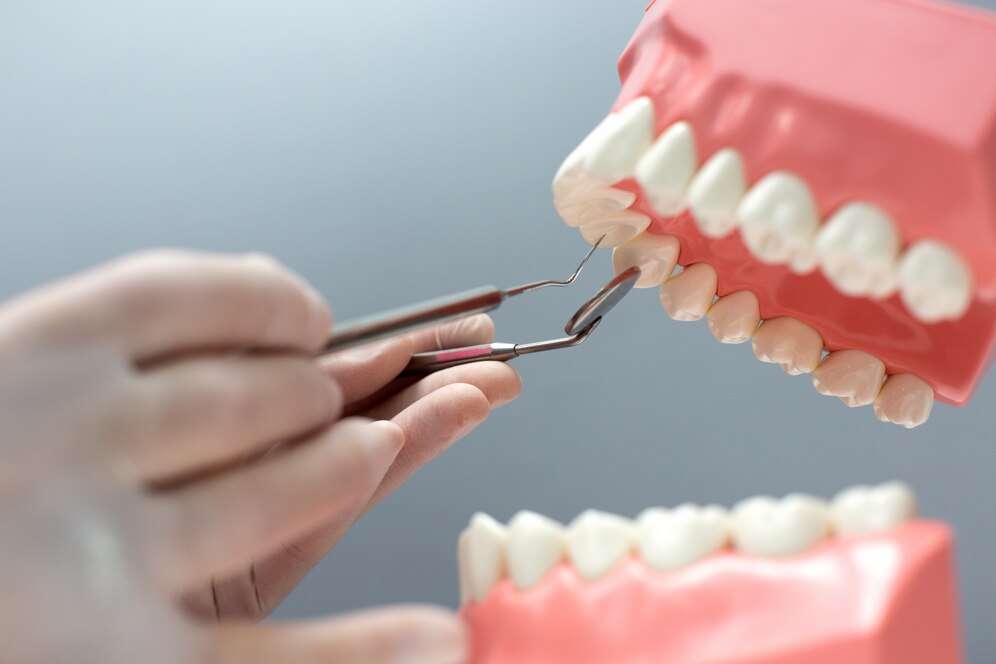
Zirconia has revolutionized the field of dentistry, particularly prosthodontics (dental restorations), thanks to its combination of mechanical strength and natural aesthetics. This article reviews the evolution of zirconia materials in dental prosthetic applications, covering their types, challenges, and prospects.
Advantages of Zirconia as a Prosthetic Biomaterial
Based on a narrative review conducted by a student of the Faculty of Dentistry, Universitas Gadjah Mada, Nicholas, under the supervision of drg. Murti Indrastuti, M.Kes., Sp.Pros(K) and Dr. drg. Sri Budi Barunawati, M.Kes., Sp.Pros(K): Zirconia is a ceramic material with mechanical properties similar to metals. Patients increasingly prefer zirconia due to its superior aesthetics compared to metals.
Common types of zirconia used include:
- Y-TZP (Yttrium Cation-Doped Tetragonal Zirconia Polycrystal)
- Mg-PSZ (Magnesium Cation-Doped Partially Stabilized Zirconia)
- ZTA (Zirconia Toughened Alumina)
Clinical Applications and Aesthetics
Zirconia is widely used in various prosthetic applications, such as veneers, single crowns, fixed partial dentures, posts, implants, and abutments.
Clinically, zirconia offers superior aesthetics compared to metals, with a more neutral color and high adaptability.
Mechanical Strength and Translucency Issues
- Zirconia has mechanical strength close to that of metals, making it resistant to high chewing loads and fractures.
However, its main drawbacks include:
- Lower translucency compared to glass-ceramic materials, making it less natural-looking for anterior teeth.
- Susceptibility to Low Temperature Degradation (LTD), i.e., structural degradation at low temperatures that may affect long-term durability.
Evolution of Zirconia Materials: From 3Y to 5Y
Recent developments are categorized by yttria content, such as:
| Zirconia Type | Yttria Conten | Strength (MPa) | Aesthetic Appeal | Ideal Application |
| 3Y (tetragonal) | 100% | ~1000-1500 | Low | Posterior areas, high strength |
| 4Y (medium translucency) | ~75% tetragonal, 25% cubic | ~600-1050 | Medium | Anterior & posterior |
| 5Y (high translucency) | ~50% tetragonal, 50% cubic | ~500-700 | High | Maximum aesthetics in anterior |
Clinical Challenges and Adhesion Technology
Despite zirconia’s strength and aesthetics, bonding zirconia crowns to teeth remains challenging.
- Cementation protocols require special treatment, especially cleaning contamination with MDP-containing materials to achieve optimal resin bonding. Lack of proper isolation can reduce bond strength by up to 50%.
References
Nicholas, drg. Murti Indrastuti, M.Kes., Sp.Pros(K); Dr. drg. Sri Budi Barunawati, M.Kes., Sp.Pros(K), Zirconia and Its Use in Prosthodontics, https://etd.repository.ugm.ac.id/penelitian/detail/204687