
Many scientific publications fail to be accepted in international journals not due to poor research quality, but because the authors have not yet mastered the strategies and supporting components of publication. In fact, scientific writing skills are an essential requirement for the academic career development of lecturers.
Recognizing this importance, FKG UGM organized a Training of Trainer (ToT) for Clinical Publication Mentors on Wednesday, 23 July 2025. The activity was attended by lecturers from various departments, who will later serve as mentors for scientific writing in their respective units.
Dr. drg. Ananto Ali Alhasyimi, MDSc., Sp.Ort(K), Head of the Research Unit at FKG UGM, stated that this program aims to strengthen the scientific writing capacity of lecturers. “We hope that participants can transfer this knowledge and skill to their colleagues in their departments,” he said.
Meanwhile, drg. Silviana Farrah Diba, Sp.RKG(K), coordinator of the program, conveyed that the outcome of this ToT is expected to produce at least 12 publications ready to be submitted to journals indexed at minimum in SINTA 2 or Scopusby the end of December 2025.
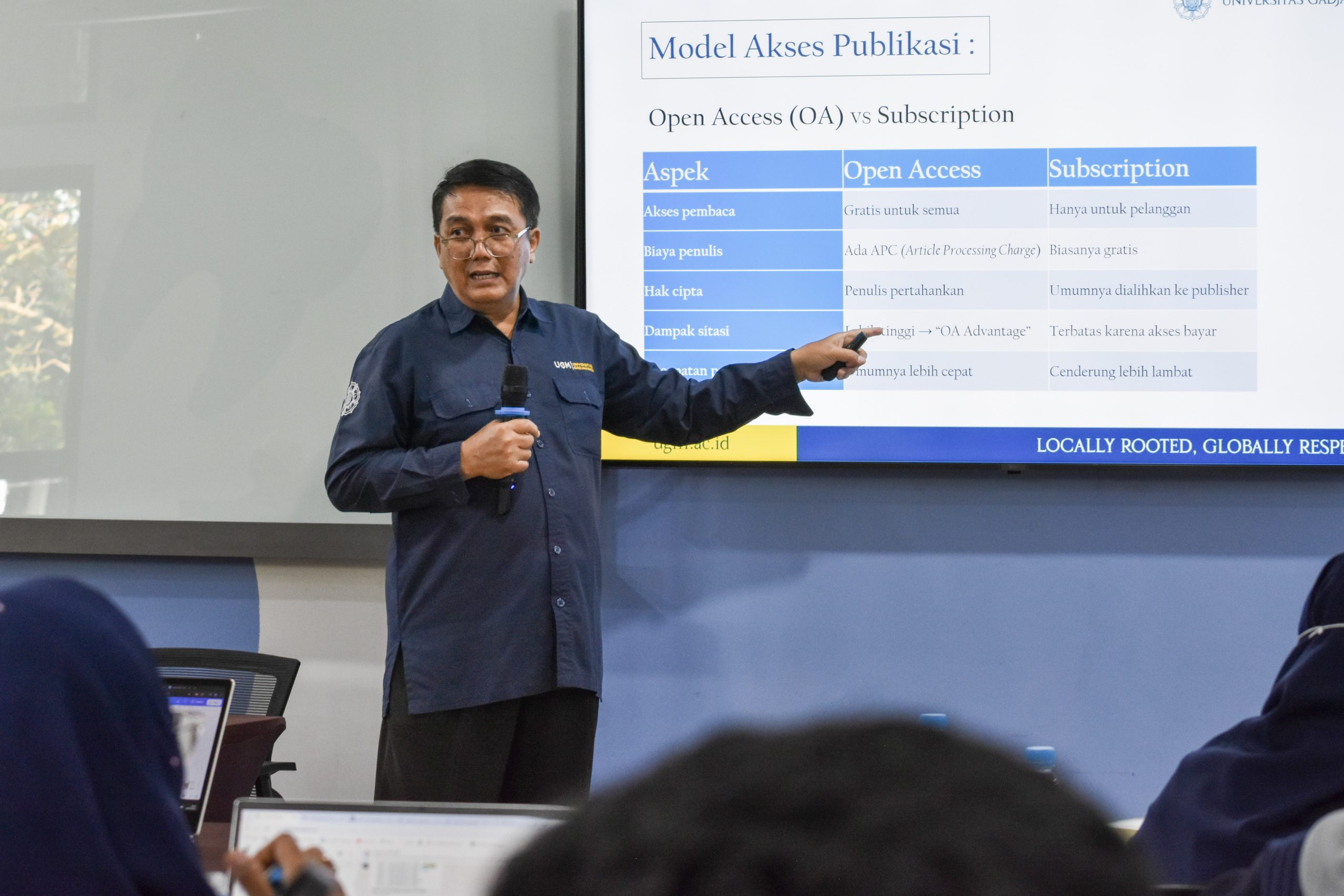
The program consisted of two main sessions. In the first session, Prof. drg. Supriatno, M.Kes., M.DSc., Ph.D. delivered material titled Submission Strategies and Overview of International Publications. In his presentation, Supriatno emphasized that the success of a publication is determined not only by the quality of research but also by the right submission strategy.
“Authors must understand the journal’s requirements in detail, including formatting guidelines and manuscript structure. A manuscript must also begin with a strong introduction that clearly, logically, and relevantly outlines the research problem,” explained Supriatno. He further added that a sharp literature review and well-defined research objectives will strengthen the novelty of a publication.
The second session was led by drg. Aryan Morita, M.Sc., Ph.D., who presented material on Visualization and Supporting Components. Aryan explained the importance of graphical abstracts in scientific publications. “Agraphical abstract is a visual summary that captures the core of the research in a single clear and comprehensible image,” she said.
Beyond appealing design, a graphical abstracts must clearly and concisely deliver the main message of the research. Authors must be able to identify the key message, sketch an initial concept, choose appropriate design tools, and then create visual elements with a clear layout.
At least five common mistakes occur in graphical abstractspreparation: excessive text, cluttered layout, poor image quality, visuals that do not reflect the publication content, and overly complicated design. “These mistakes can make the graphical abstracts blur the main message rather than highlight it,” she concluded.
Author and Photographer: Fajar Budi Harsakti