
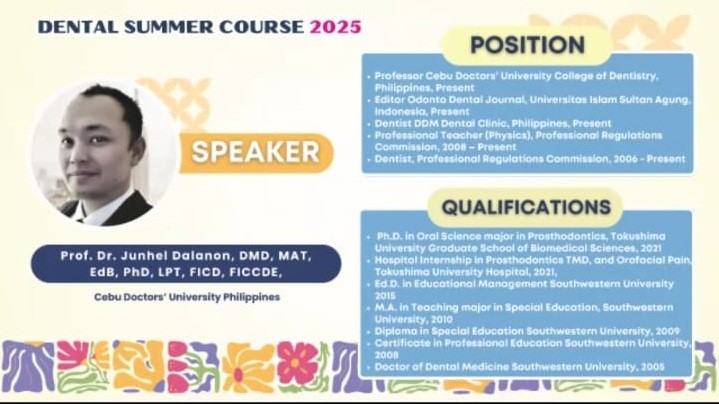
The webinar titled Transforming Oral Health Care with Digital Dentistry was engaging, moderated by drg. Daniel Rino Krismasurya. Participants actively asked questions and responded to Prof. Junhel Dalanon’s presentation regarding the challenges faced by developing countries in integrating digital technology into dental practice, as well as the wise application of AI in dental science. The revolution in dental care is being prepared to improve quality and efficiency, including: enhanced diagnostic accuracy, precision in aesthetic dental restorations, digital technology reducing work time so restoration processes become faster, minimizing human error with the support of 3D printing technology, supporting infrastructure, and enabling patients to consult dentists online. Although investment in digital technology for dental medical needs is quite costly, it shortens consultation times and allows patients to be served more quickly. CAD/CAM (Computer-Aided Design / Computer-Aided Manufacturing) technology functions in designing dental prosthesis fabrication, including crowns, braces, and restorations for damaged or decayed teeth. Artificial Intelligence (AI) with its algorithms assists in analyzing radiographs, detecting pathologies, and supporting dental treatment planning.
For clinical use cases, these include detecting dental caries, oral diseases, and oral cancer, as well as predictive analysis for risk assessment. Chatbot and voice message technologies help patients in dental health consultations. The impact of digital innovation in dentistry is to facilitate communication between dentists, patients, and laboratories. At the same time, in carrying out planning and monitoring, performance efficiency and data distribution become faster across all platforms. In the field of dental education, integrating digital dentistry requires curriculum development, as well as integration into both pre-clinical and clinical education.
Simulation-based education is highly recommended so that students can practice using digital dentistry technologies. To achieve this, in-depth studies and a blueprint for mapping digital technology in dentistry are required. Digitalization of dentistry is indeed disruptive, but very positive. It offers new opportunities to improve patient awareness, efficiency, convenience, and flexibility in dental health consultations.
Author: Andri Wicaksono | Photo: Doc. Summer Course 2025